
MOHA AHN Jong Yuen
Overview
Selected Solo Exhibitions
Selected Group Exhibitions & Biennales
Major Public Art & Permanent Installations
MOHA AHN Jong Yuen has also developed a substantial body of public art and architectural installations, including works commissioned for cultural institutions, corporate buildings, public spaces, and architectural environments.
Selected projects include:
His installation practice incorporates light, glass, stainless-steel super-mirrors, LED technology, and spatial structures to create immersive environments in which light becomes an active element of the architecture and the viewer’s perception. (UM Gallery)
Artist’s Statement
My artistic practice begins with a fundamental question: What is light, and what does it reveal about existence?
For me, light is not simply a physical phenomenon or a means of illuminating an object. It is a fundamental force of life, a language through which the invisible can become perceptible. Light exists between presence and absence, between appearing and disappearing, and between the beginning and the end of things. Throughout my practice, I have explored light as both a material and a metaphor for existence, time, memory, and transformation.
My work has evolved continuously across painting, sculpture, installation, photography, video, kinetic art, and new media. Although the materials and technologies have changed, my central concern has remained the relationship between light, time, space, and human existence. I do not regard these different media as separate disciplines. Rather, each medium provides another way of approaching the same fundamental questions.
In my early paintings, I explored images and traces of human existence through the accumulation and transformation of marks. Over time, I began to move beyond the limitations of the two-dimensional surface, experimenting with mirrors, glass, stainless steel, epoxy, light, sound, and moving images. This expansion from the plane into physical and immersive space allowed me to explore not only what an image represents, but also how an image is perceived and how perception itself changes.
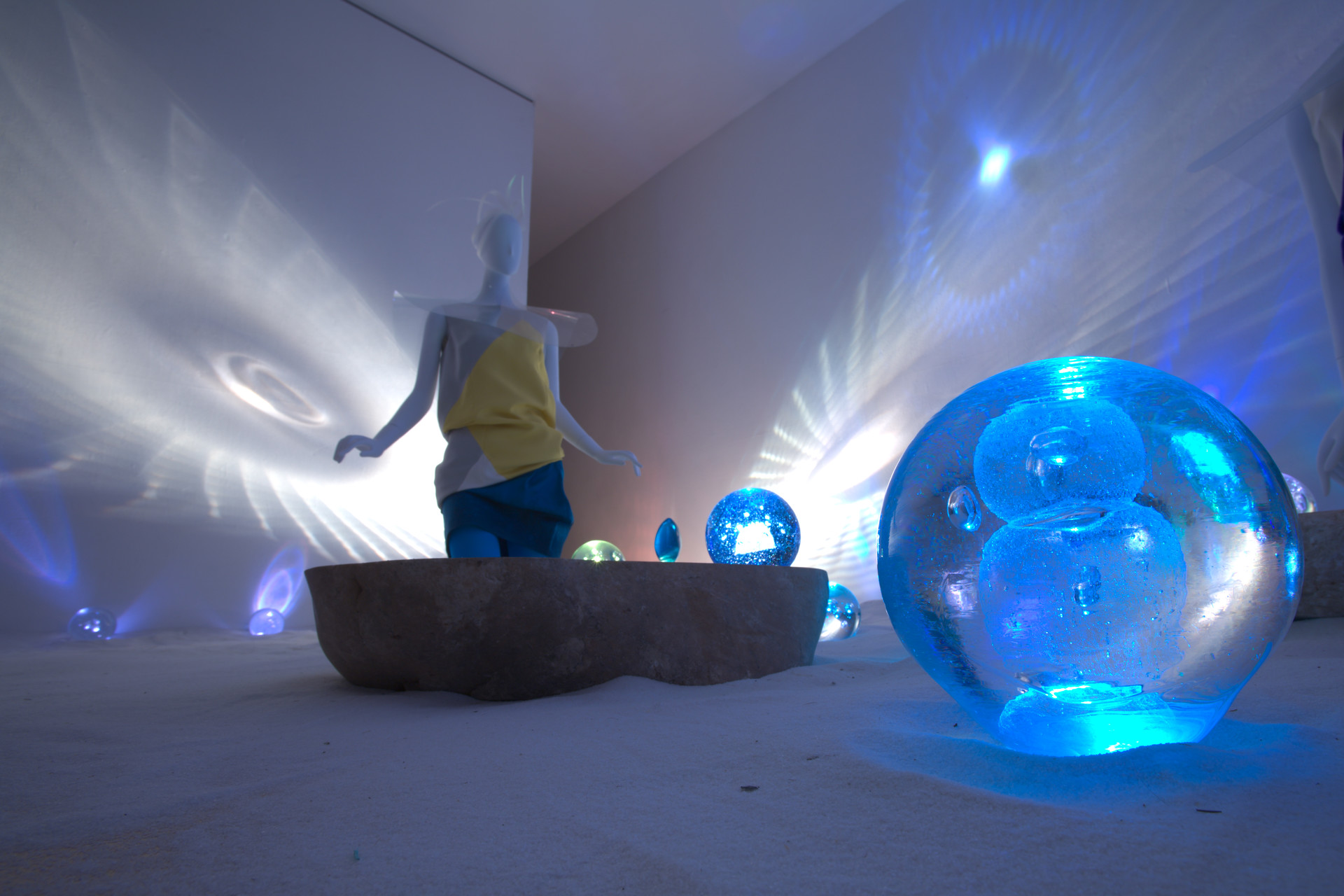
A significant turning point in my practice was my exploration of light as an independent artistic medium. I create luminous environments using glass spheres, mirrors, LED technology, stainless steel, and other reflective and translucent materials. Rather than simply illuminating a sculpture or architectural space, light becomes the sculpture itself. It moves through, reflects from, penetrates, and multiplies across the surrounding environment, creating what I think of as “drawings of light.” (Mohaahn)
The glass sphere is particularly important to this process. I have developed my own methods of incorporating light into glass forms, allowing light to emerge from within the object rather than simply falling upon it from outside. In this way, the illuminated object becomes a meeting point between interior and exterior, between material and immaterial, and between the visible body and the invisible energy contained within it. (Abeera Aatique)
I am interested in the moment when light ceases to be something we merely look at and becomes an environment that we physically experience. A change in the viewer’s position can alter reflections, shadows, colors, and spatial relationships. The work therefore has no single fixed image. It continuously changes according to the movement and perception of the viewer.
This relationship between viewer and artwork is essential to my practice. I want the audience to enter the work rather than simply stand before it. As the viewer moves, the work changes; as the light changes, the surrounding space changes; and as space changes, perception changes again. The artwork becomes an ongoing process rather than a completed object.
My installations often incorporate repetition and multiplication. A single point of light can become hundreds of points; one reflection can generate another reflection; a single image can expand into an apparently infinite field. This multiplication is not merely a visual effect. It reflects my interest in the fundamental structure of the universe, in which individual elements exist simultaneously as separate entities and as parts of a larger whole.
This idea is especially evident in my kaleidoscopic works. By combining images, reflections, animation, and light, I create continuously multiplying patterns that suggest an infinite expansion of time and space. The kaleidoscope becomes a metaphor for existence itself: countless individual forms are constantly reorganized into new relationships, disappearing and reappearing in different configurations. (Mohaahn)
At the center of this exploration is the relationship between creation and extinction. I am interested in the fact that existence is never static. Everything emerges, transforms, fades, and eventually disappears. Yet disappearance can also become the beginning of another form. Light makes this cycle visible. It appears, spreads, changes, and disappears, only to emerge again in another form.
For this reason, my work often considers the apparent oppositions between being and non-being, life and death, presence and absence, individual and collective, and part and whole. Rather than treating these as absolute opposites, I see them as interconnected states within a larger continuum.
Time is therefore another essential element of my work. We experience life through the accumulation of moments, yet time itself cannot be physically grasped. Light allows me to visualize this invisible dimension. Through reflections, repetition, movement, changing illumination, and layered images, I attempt to give form to the passage of time.
My earlier series “The Beginning of New Days” emerged from this understanding. I created two-dimensional works by layering and transforming constantly changing images of light through epoxy dripping techniques. These images were subsequently expanded into moving images, allowing the visual language of painting to enter the temporal dimension of video and installation. The work moves from a fixed image toward an image that continuously generates itself. (Mohaahn)
Nature is another important source within my practice. Water, rivers, lakes, waves, stars, and the changing light of dawn and dusk provide recurring points of reflection. I am fascinated by the subtle transition between brightness and darkness, particularly by the moment when light begins to fade or emerge almost imperceptibly. These transitions remind us that nothing remains permanently fixed.
In my works involving stainless steel and reflective surfaces, I use the material not simply as a support but as a means of creating another dimension of perception. The polished surface reflects the viewer and the surrounding environment, while simultaneously distorting or fragmenting them. The viewer therefore encounters an image that is both familiar and uncertain—a reflection of the self that is constantly changing. (UM Gallery)
Sound also enters some of my installations as an extension of light. When light, sound, reflection, movement, and space come together, the work becomes closer to an environment than to an isolated object. I am interested in creating a multisensory experience in which the viewer can feel the passage of time and the transformation of space rather than simply observe an image.
My practice has also continued to incorporate new technologies. Digital media, LED lighting, sensors, moving images, and more recently AI-related technologies provide new possibilities for exploring the relationship between the physical and the immaterial. I do not use technology simply for its novelty. Instead, I regard technology as another instrument through which longstanding questions about light, perception, existence, and the future can be reconsidered. My recent work continues this movement toward a post-digital environment, where physical materials and digital images can coexist and influence one another. (Jirisan Biennale)
Ultimately, I see my work as an attempt to make the invisible visible.
Light is everywhere, yet it cannot be held. Time is constantly passing, yet it cannot be stopped. Existence is continuously changing, yet we often experience it as something fixed. Through light, reflection, movement, sound, and space, I seek to reveal these subtle transformations.
My works invite the viewer to pause, enter, move, and look again. What appears to be a single point of light may become a universe of countless reflections. What seems to be an object may become an environment. What appears to be an ending may become a beginning.
Light, for me, is ultimately a passage between what exists and what is yet to come—a visual language through which time, space, life, and the infinite can be experienced.
Biography
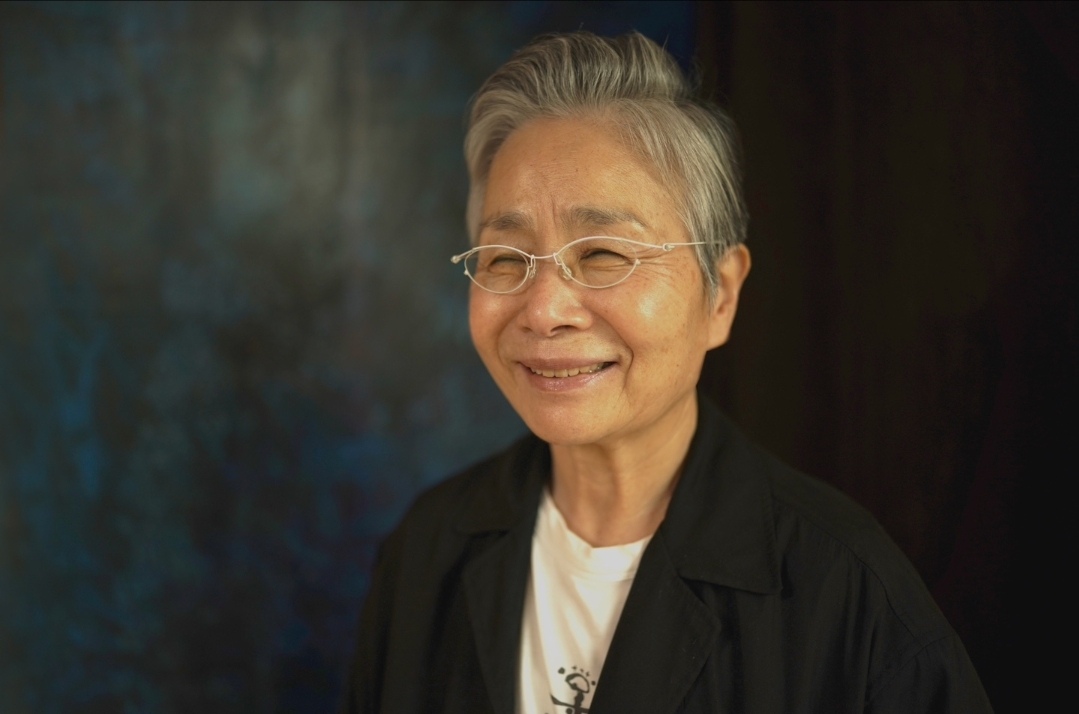
MOHA AHN Jong Yuen (b. 1952, Miryang, Korea) is a Korean contemporary artist whose multidisciplinary practice spans painting, sculpture, installation, light art, media art, and public art. Over more than four decades, he has continuously explored light, time, space, existence, creation and extinction, developing a distinctive visual language that transforms light into an immersive artistic experience.
Ahn studied Western painting at Dong-A University in Busan from 1970 to 1972 and continued his studies in New York at the School of Visual Arts, completing his MFA in 1992. His early practice was rooted in painting, but from the 1990s onward he progressively expanded his artistic vocabulary into three-dimensional works, mirror-based installations, sculpture, photography, video, and large-scale spatial installations. (DA-Arts)
Light has remained a central subject throughout Ahn’s practice. He regards light not simply as a visual or physical phenomenon, but as a fundamental element of life and a medium through which questions of existence can be contemplated. His works frequently address the transient nature of light and its relationship to time, space, life and death, presence and absence, and creation and extinction. (양평시민의소리)
Ahn’s light-based installations often incorporate glass spheres, mirrors, stainless steel, LED lighting, and other technological materials. Through these materials, he creates what has been described as “light drawings,” extending light across walls, floors, ceilings, and architectural spaces. His use of illuminated glass spheres, in particular, creates immersive environments in which light appears to multiply, move, and transform according to the surrounding space and the viewer’s perception. (Mohaahn)
His artistic experimentation has also led to the development of patented technologies related to lighting. Among them are a patented method for producing illuminated glass covers with internal bubbles and a registered design for a lighting diffusion device. These technological explorations form part of his broader interest in combining artistic imagination with new materials and media. (Mohaahn)
Ahn has presented numerous solo exhibitions at major galleries and cultural institutions in Korea and abroad. His significant exhibitions include Gana Gallery, Seoul (1989); Park Ryu-sook Art Gallery, Seoul (1995); IHN Gallery, Seoul (2000, 2004); Kongkan Gallery, Busan (2001, 2006); UM Gallery, Seoul (2007); Hakgojae Gallery, Seoul (2010); Phoenix Island / Ando Tadao’s Glass House, Jeju (2010); Emirates Palace Gallery, Abu Dhabi (2013); Busan Museum of Art (2015); Oil Tank Culture Park, Seoul (2018); Yeulmaru, Yeosu (2019); Summit Prugio, Seoul (2022); Masan Museum of Modern Art (2023); and Bongsan Cultural Center, Daegu (2024). (UM Gallery)
His international exhibition history includes presentations in New York, Paris, Yokohama, Abu Dhabi, Washington D.C., and other international venues. Notable exhibitions include French Critical Figurative Art Exhibition at the Grand Palais, Paris (1986), Visions’ in Between at the Rockefeller Center, New York (1994), SORI at the Visual Arts Gallery, New York (2006), Borderless at the Yokohama Creativity Center (2009), Luminescence at The Sylvia Wald and Po Kim Art Gallery, New York (2016), and exhibitions associated with the New Silk Road project in the UAE. (UM Gallery)
His work has also been presented in major public-art projects and permanent installations, including projects at Kyobo Book Centre in Gwanghwamun, National Cancer Center, Phoenix Island’s Mario Botta-designed Agora in Jeju, Samsung Life Insurance’s Jongno building, Donggang Ecological Park, the 2nd Gwangju Biennale, and Jongno Tower, among others. (UM Gallery)
Ahn’s works are held in collections including the National Museum of Modern and Contemporary Art, Korea; Hoam Museum of Art; Busan Museum of Art; Arario Museum; SongEun Art and Cultural Foundation; Sootdae Museum; Samsung Electronics; Hana Bank; LG; and other institutional and corporate collections. His works are also held internationally in the United Arab Emirates, Hong Kong, Singapore, Taiwan, Japan, Qatar, and the United States. (Mohaahn)
Throughout his career, MOHA AHN Jong Yuen has continued to move between painting, sculpture, installation, light, technology, and public art. His practice is characterized by an ongoing search for new forms of visual experience, using light as both a material and a metaphor for the changing nature of existence. His recent works further incorporate digital technology, sensors, data, sound, and AI-related media, extending his long-standing investigation of light, perception, time, and human experience into the post-digital era. (Jirisan Biennale)
Works
Lenticular
ø55 cm2023

New days dawning 2Lenticular
ø55 cm2023
Lenticular 105 x 90 cm 2022

New days dawning 1Lenticular 105 x 90 cm 2022
Lenticular
ø55 cm2023

New days dawning 3Lenticular
ø55 cm2023
Lenticular
ø55 cm 2023

New days dawning 4Lenticular
ø55 cm 2023
Lenticular
ø55 cm 2023

New days dawning 6Lenticular
ø55 cm 2023
Lenticular
ø55 cm 2023

New days dawning 7Lenticular
ø55 cm 2023
Lenticular
ø55 cm 2023

New days dawning 8Lenticular
ø55 cm 2023
Lenticular
ø55 cm 2023

New days dawning 5Lenticular
ø55 cm 2023
Stainless Steel Light Sphere

New days drawn 9Stainless Steel Light Sphere

